

Loading...
Loading...
Yukon Solitaire rules come down to two departures from Klondike: all 52 cards are dealt to the tableau at the start, and any face-up card can be moved along with every card stacked on top of it, whatever order those cards happen to be in. There is no stock pile and no waste pile. What sits on screen after the deal is everything you will ever get.
You win by moving all 52 cards to four foundation piles, each built up in one suit from Ace through King.
Seven columns hold 1, 6, 7, 8, 9, 10 and 11 cards, left to right. Column 1 holds a single face-up card and hides nothing. Every column after it hides one more card than the column to its left, and carries exactly five face-up cards on top.
| Column | Face down | Face up | Total |
|---|---|---|---|
| 1 | 0 | 1 | 1 |
| 2 | 1 | 5 | 6 |
| 3 | 2 | 5 | 7 |
| 4 | 3 | 5 | 8 |
| 5 | 4 | 5 | 9 |
| 6 | 5 | 5 | 10 |
| 7 | 6 | 5 | 11 |
| Total | 21 | 31 | 52 |
To lay this out with a physical pack:
Step 2 raises columns 2 through 7 from one face-up card to five, which produces the table above. Two wrong descriptions circulate. One gives four face-up cards per column, which accounts for only 46 of the 52 cards. The other has the whole deck starting face up, which loses the 21 hidden cards the game is built around. Nothing is held back either: there is no stock, no waste pile and no redeal, because there is nothing left to deal.
Yukon changes two of Klondike's rules and leaves the rest alone. The tableau still builds down in alternating color, the foundations still build up in suit from Ace to King, and empty columns still take Kings only.
The first change is the missing stock. Klondike holds back 24 cards and feeds them to a waste pile one or three at a time, so a stalled board can often be freed by turning fresh cards. Yukon has no such rescue. The only new information that ever enters the game is a face-down card turning over.
The second change is what may travel as a group. Klondike moves a run only when it already sits in perfect descending alternating-color order. Yukon moves any face-up card together with the pile on top of it and never inspects that pile at all. A card a Klondike player would write off as buried is, in Yukon, immediately playable.
Pick up any face-up card in any column, however deep it sits, and every card above it comes with it as a block. Only two cards are ever tested: the card you picked up and the card it lands on. The rest are passengers.
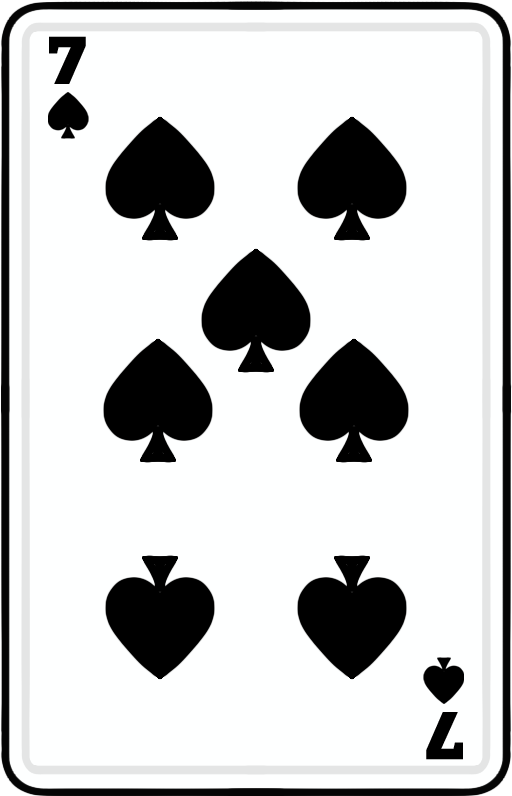
Take a column reading, from bottom to top, 7 of spades, King of diamonds, 3 of clubs, Ace of hearts. Those four cards form no sequence and never will. If an 8 of hearts is exposed at the end of another column, all four move onto it as one unit, because the 7 of spades is one rank lower than the 8 of hearts and the opposite color. The King, the 3 and the Ace play no part in the test.
Three limits apply to every group move:
Tableau columns build down in alternating color: a red 9 on a black 10, a black 4 on a red 5. King is high, Ace is low, and the sequence does not wrap. Nothing can ever be placed on an Ace, since no rank sits below it, and a King can only move to an empty column.
The rank and color test applies at the join and nowhere else. Ordered runs inside a column look tidy and earn nothing mechanically. Yukon grants them no privilege of any kind, which is why players arriving from Klondike spend so many moves grooming sequences that buy them nothing.
Four foundations, one per suit, each built up from Ace to King. Only an Ace can start a foundation, and once it does, that pile is locked to its suit.
Foundations take one card at a time, and only from the exposed end of a column. The group move is a tableau privilege and never applies here. An Ace sitting under six other cards cannot jump to a foundation; you have to shift all six onto other columns first. This is the point competing write-ups most often muddle, and getting it wrong makes the game look far easier than it plays.
In our game a card played to a foundation stays there. Some other versions let you pull a card back down into the tableau, so it is worth knowing which behavior you are dealing with if you have played Yukon elsewhere. Ours offers no route back, which makes a card banked early gone for good.
Only a King, or a group whose bottom card is a King, may move into an empty column. Because of the group-move rule, a King buried under unrelated face-up cards still qualifies, and it brings the whole pile with it.
An empty column stays empty until you fill it. No stock exists to feed one, so a cleared column is a scarce asset rather than a routine step in the game. Emptying column 1 costs almost nothing, since it holds one card and hides none, but the space only pays off once you know which King is going into it.
Two events score. Turning a face-down card is worth 5 points, and moving a card to a foundation is worth 10. Since a won game turns all 21 face-down cards and sends all 52 cards up, every win scores exactly 625.
The game is won when all four foundations hold 13 cards, Ace through King in suit, and the tableau is bare. It is lost when no legal move remains and the foundations are short. With no stock to turn, a blocked Yukon position stays blocked.
| Element | Rule |
|---|---|
| Deck | One standard 52-card deck, all of it dealt |
| Tableau columns | 7, holding 1, 6, 7, 8, 9, 10 and 11 cards |
| Face-down cards | 21, running 0, 1, 2, 3, 4, 5, 6 across the columns |
| Face-up cards | 31, one in column 1 and five in each of columns 2 through 7 |
| Stock and waste | None |
| Redeals | None |
| Tableau building | Down in alternating color, a red 9 on a black 10 |
| Group moves | Any face-up card plus everything on top of it, in any order |
| Foundation moves | One card at a time, from the exposed end of a column |
| Foundation building | Up in suit, Ace to King |
| Empty columns | Kings, or groups whose bottom card is a King |
| Scoring | 5 per face-down card turned, 10 per card to a foundation |
| Win condition | All 52 cards on the foundations |
Play Yukon Solitaire to deal a hand and work a group move with real cards. Anything these rules leave open is covered in the Yukon FAQ. For deals that change one rule and the whole difficulty with it, read the Yukon variants page, which opens with Russian Solitaire. Scorpion applies the same group move to a different layout, and every solitaire game we host sits one page away.
All 52 cards are on the table from the first move. The only thing between you and the foundations is how well you read them.
Play Yukon Solitaire Now