

Last updated
Hearts Card Game Rules
The goal of Hearts is to finish with the lowest score by losing the tricks that hold hearts and the Queen of Spades. The rules below are the ones our game plays, card for card. After them come the rules for other numbers of players, the best-known variants, and the house rules other tables use.
If you are new to the game, start with the eight-step guide to playing Hearts under the game itself.
Players, Cards, and the Deal
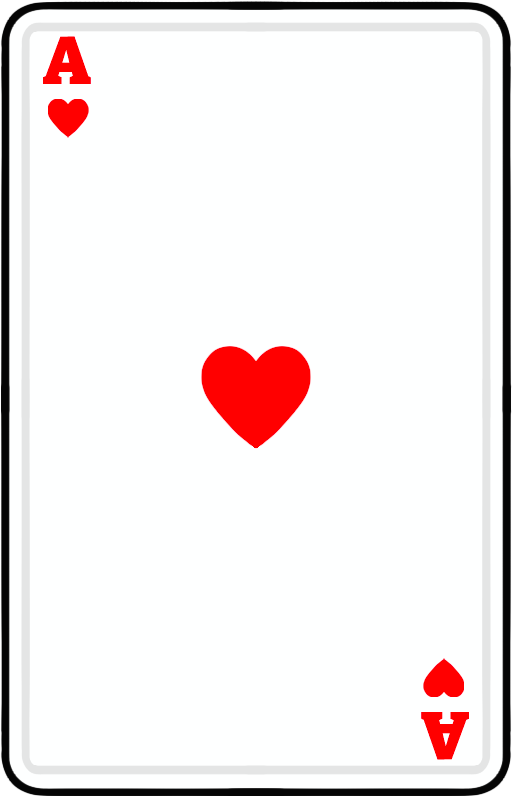
Hearts is a game for four players, each playing alone. It uses a standard 52-card deck with no jokers. In every suit the cards rank from the Ace, highest, down to the 2, and there is no trump suit.
The dealer deals the whole pack face down, one card at a time and clockwise, so each player holds 13: 13 + 13 + 13 + 13 = 52. The deal passes to the left after each hand. In our game the shuffle deals for you: every hand comes from our provably fair shuffle, and a challenge link or the daily Hearts deal replays every hand of a game, not only the first.
Passing
After the deal, each player chooses three cards and passes them face down to another player. You must choose your three before you look at the three passed to you. The direction changes every hand, in a cycle of four:
| Hands | Pass | From your seat (South) |
|---|---|---|
| 1, 5, 9 ... | Left | You pass to West and receive from East |
| 2, 6, 10 ... | Right | You pass to East and receive from West |
| 3, 7, 11 ... | Across | You and North swap three cards |
| 4, 8, 12 ... | Hold | Nobody passes |
The pass is exactly three cards, no more and no fewer, and in our game the play does not start until all four players have passed. On the hold hand everyone plays the cards they were dealt.
Other passing schemes exist. Tournament rules drop the hold hand and pass every time. The earliest rules passed only to the left, and some tables replace the hold with a scatter pass, one card to each opponent.
Playing a Hand
The First Trick
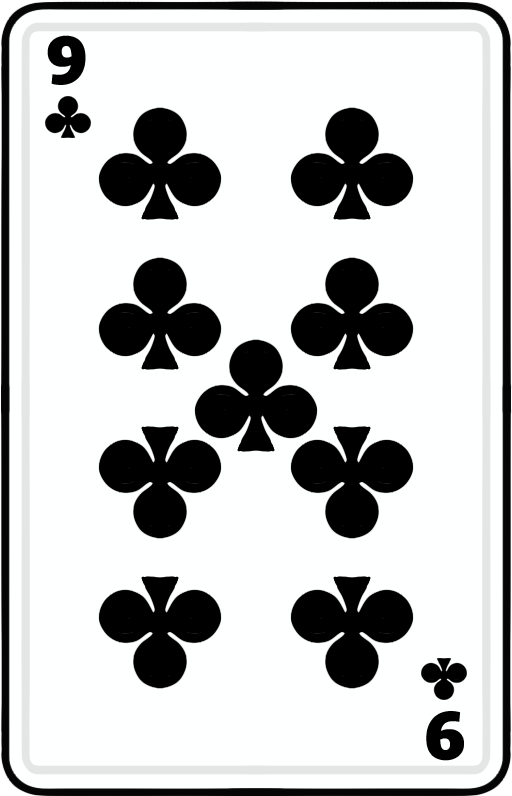
The player holding the 2 of clubs after the pass must lead it. Everyone else follows with a club if they can. A player with no clubs must play a card that is neither a heart nor the Queen of Spades, so the first trick never carries points. The only exception is a hand made up entirely of point cards, which may play one.
Following Suit and Winning Tricks
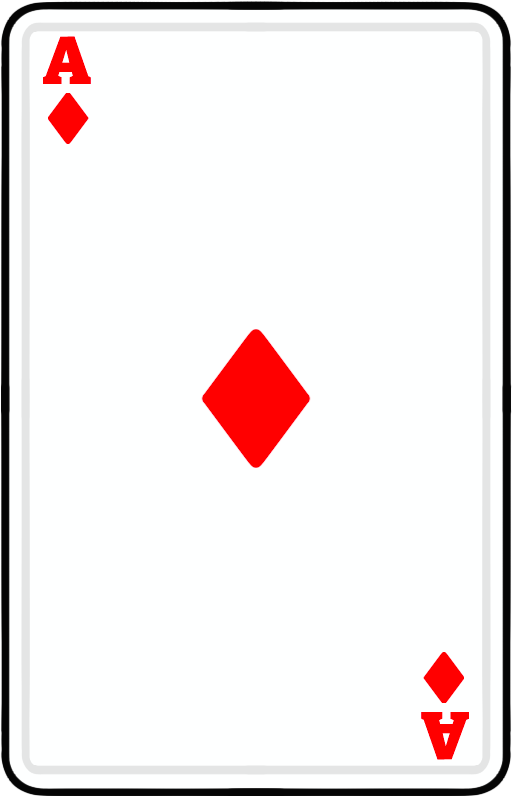
Play goes clockwise. You must play a card of the suit led if you have one; only when you have none may you play a card of another suit. The highest card of the suit led wins the trick, whatever else is played to it, and the winner leads the next trick.
Failing to follow suit when you could is called reneging. Our game only accepts legal cards, so nobody can renege.
Breaking Hearts
You may not lead a heart until hearts are broken. That happens the moment a heart or the Queen of Spades falls on any trick, and our game counts the Queen whether she is thrown on another suit, played to a spade lead, or led.
Some tables let only a heart break hearts, and many let a player holding just hearts and the Queen lead a heart instead. Agree on both before the first deal.
Leading the Queen of Spades
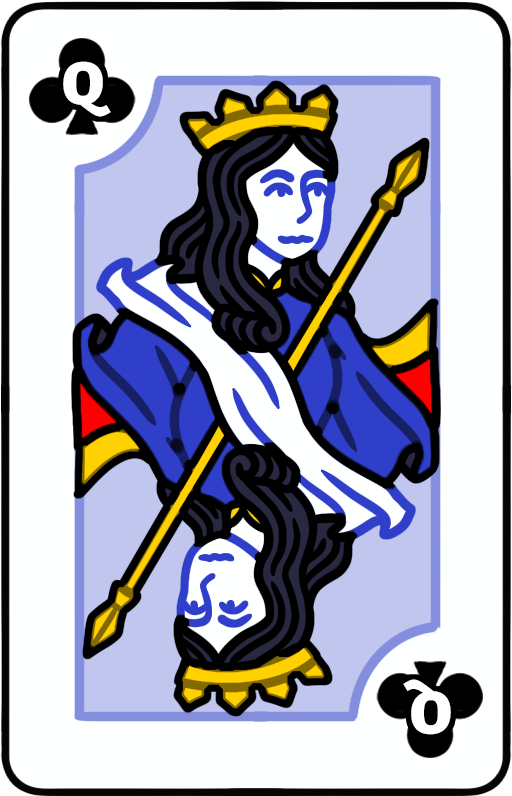
The Queen of Spades may be led at any time after the first trick, before or after hearts are broken, and nobody has to play her at the first chance. Leading low spades to force her out of the hand that holds her is called smoking out the Queen.
Scoring
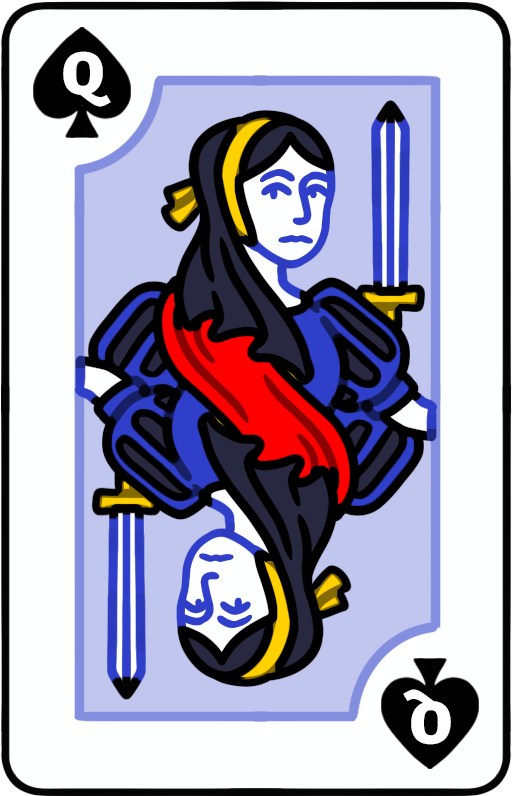
At the end of each hand, every player counts the point cards in the tricks they won: 1 point for each heart and 13 for the Queen of Spades. No other card counts. There are 26 points in every hand, so the four scores for a hand always add up to 26, except on a moon hand, when they add up to 78.
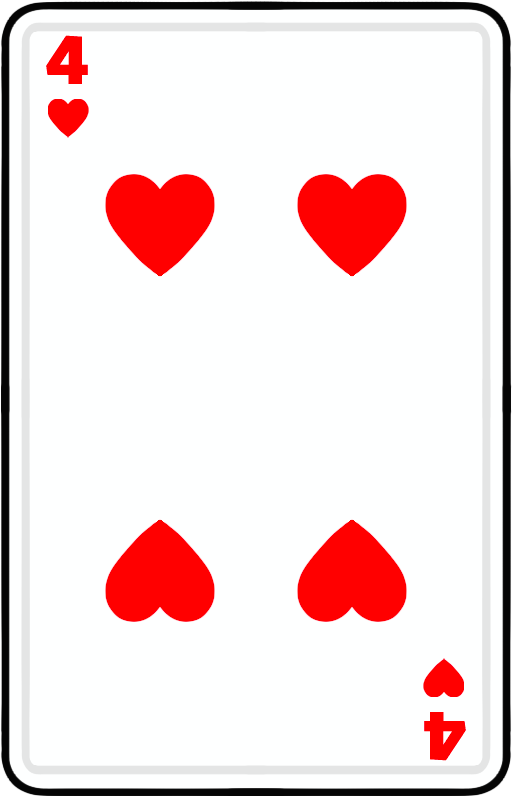
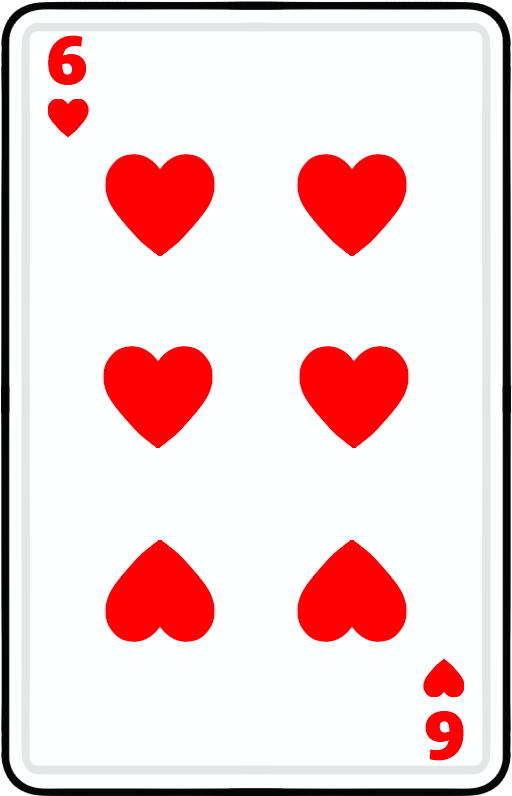
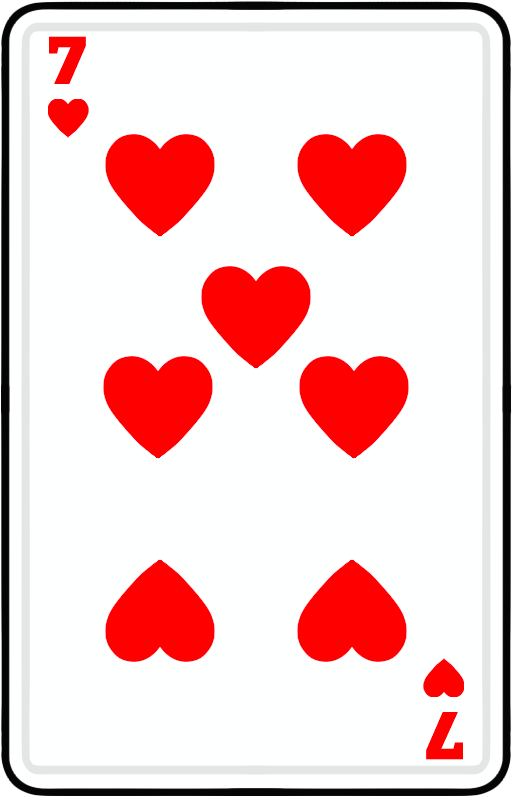
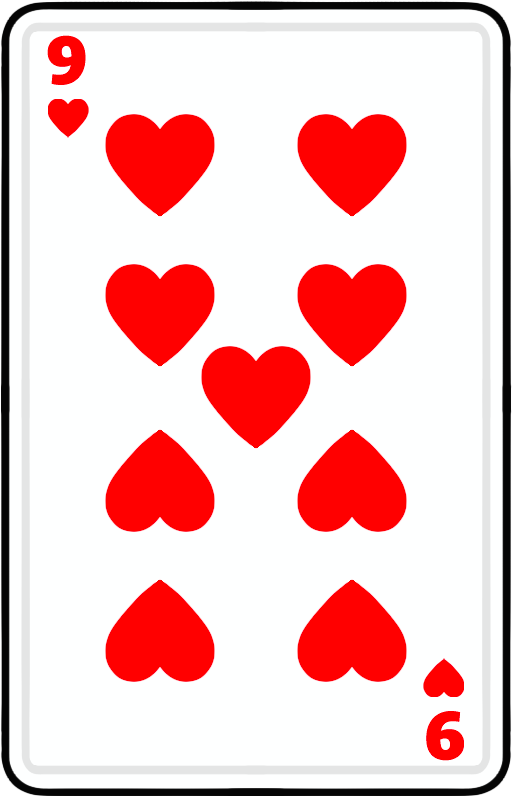
A hand in which you take 3 hearts, West takes the Queen of Spades, North takes 6 hearts and East takes 4 scores 3, 13, 6, and 4. Add each hand to the running totals, as in this four-hand Hearts scoresheet.
Shooting the Moon
A player who wins all 14 point cards in one hand, the 13 hearts and the Queen of Spades, has shot the moon. In our game they score 0 for the hand and each other player scores 26. If you are on 40 and shoot the moon while West, North, and East are on 55, 61, and 70, they go to 81, 87, and 96 and you stay on 40.
Our game scores every moon this way, even when the 26 ends the game against the shooter. Taking 25 of the 26 is not a moon: if a single heart goes to someone else, you score the 25 you took.
Adding 26 to everyone else is called the old moon; taking 26 off the shooter's own score is the new moon. Many tables let the shooter choose, or allow the new moon only when the old one would end the game with the shooter behind. Shooting the sun, winning all 13 tricks, earns an extra reward at some tables; in our game it scores as a moon.
Winning the Game
Scores carry from hand to hand. After each hand, if any player has 100 points or more, the game ends and the player with the lowest score wins. Exactly 100 is enough to end it; some tables reset a score of exactly 100 to 50 or to 0, and ours does not.
If two or more players tie for the lowest score when the game ends, another hand is dealt, and play goes on until one player is lowest alone. A tie anywhere else on the scoreboard does not matter.
Hearts for 2, 3, 5, 6, and 7 Players
The four-player game uses all 52 cards. For other numbers, take low cards out so the pack divides evenly. The point cards normally stay in, so a hand still holds 26 points; the exception is a six-player deal that removes all four 2s, the 2 of hearts among them, which leaves 25.
Three Players
Remove the 2 of diamonds and deal 17 cards each: 3 x 17 = 51. The 2 of clubs leads the first trick as usual. Pass three cards left, then right, then hold, and repeat; some groups skip the hold. A second method keeps all 52 cards: deal 17 each and put the last card face down as a kitty for the winner of the first trick, 51 + 1 = 52.
Five Players
Remove the 2 of diamonds and the 2 of clubs and deal 10 each: 5 x 10 = 50. The 3 of clubs leads the first trick. A common pass cycle is left, right, two seats to the left, two seats to the right, then hold.
Six Players
Remove four low cards and deal 8 each: 6 x 8 = 48. Groups differ on which four go. Some take out all four 2s; others remove the 2 and 3 of clubs, the 2 of diamonds, and the 2 of spades. The lowest club dealt leads.
Seven or More Players
Large groups play Cancellation Hearts with two packs shuffled together, described under Hearts variants below. Seven players get 14 cards each, with 6 left over: 7 x 14 + 6 = 104.
Two Players
There is no standard two-player Hearts. One published method uses a 28-card pack, with every 3, 5, 7, 9, Jack, and King taken out; it deals one card aside, 13 to each player, and one more aside: 1 + 13 + 13 + 1 = 28. Another gives the two players a dummy hand to play as well.
Every table on this site seats four. A group of two or three can open a room from Hearts online with friends and let computer players take the seats nobody fills.
Hearts Variants
The game on this page is the one Americans call Hearts; card books call it Black Lady, after the Queen of Spades. These are its best-known relatives. None is playable here: our game is standard four-player Hearts.
Omnibus Hearts
Omnibus Hearts adds a bonus card: the Jack of diamonds, or at some tables the 10 of diamonds, takes 10 points off the score of the player who wins it. The bridge writer Ely Culbertson reported in 1950 that it was rapidly becoming the most popular form of the game.
Black Maria
Black Maria is the British relative. It suits three players, who remove the 2 of clubs and take 17 cards each, and cards are passed to the right. The Ace of spades costs 7 points and the King 10, on top of the Queen's 13, so each hand holds 43 points: 13 + 7 + 10 + 13. Hubert Phillips, who claimed to have invented it, first printed its rules in 1939.
Spot Hearts
In Spot Hearts each heart costs its face value: the 2 to the 10 at face value, the Jack 11, the Queen 12, the King 13, and the Ace 14. The hearts alone are worth 104, and the Queen of Spades is often raised to 25, so games run to a higher target such as 500.
Cancellation Hearts
Cancellation Hearts is for six or more players, with two packs shuffled together. When two identical cards fall on the same trick they cancel out and neither can win it, though their points still count. If every card of the suit led is cancelled, the trick stays on the table and goes to the winner of the next one. With two sets of point cards, each hand holds 52 points.
Partnership Hearts
Four players form two teams, partners sitting opposite. In one common version partners add their points together, and a team shoots the moon by taking all 14 point cards between them; in another, partners keep separate scores and add them up when the game ends.
Australians call the standard game Rickety Kate, and China plays a relative, Gong Zhu, with bonus cards as well as penalty cards.
Our Game and Common House Rules
Hearts is played with many house rules. This is where our game stands on the common ones:
| Rule | Our game | Other tables |
|---|---|---|
| Shooting the moon | Every other player scores 26, always | The shooter may take 26 off their own score instead, at some tables only when adding 26 would end the game against them |
| Does the Queen break hearts? | Yes, however she is played | Some tables count only a heart |
| Points on the first trick | Not allowed, unless a hand holds nothing but point cards | Some tables allow a heart on the first trick |
| Lead with only hearts and the Queen left, hearts unbroken | You must lead the Queen | Many tables allow a heart lead |
| Hand with no pass | Every fourth hand | Tournament rules pass on every hand |
| Tie for lowest when the game ends | Another hand is dealt | Some tables play on until one player is clear, as ours does |
| Jack of diamonds | An ordinary card | Omnibus Hearts: minus 10 points |
| A score of exactly 100 | Ends the game | Some tables reset it to 50 or to 0 |
Hearts Glossary
- Black Lady
- A name for the Queen of Spades, and for the standard game in which she costs 13 points.
- Black Maria
- The British relative of Hearts, with the Ace and King of spades as extra penalty cards. The name is also used for the Queen of Spades.
- Breaking hearts
- The first play of a heart, or in our game of the Queen of Spades, in a hand. After it, hearts may be led.
- Duck
- To play a card lower than the one winning the trick, so that you do not win it.
- Dump
- To throw a point card, or a dangerous high card, on a trick someone else will win, when you cannot follow suit.
- Follow suit
- To play a card of the suit led. You must do so whenever you can.
- Hold hand
- The fourth hand of the passing cycle, played with the cards dealt and no pass.
- Kitty
- Cards set aside face down when the pack does not divide evenly, usually taken by the winner of the first trick.
- Lead
- The first card played to a trick. Its suit is the one everyone must follow.
- Old moon and new moon
- The two ways to score a moon. Old moon adds 26 to every other player; new moon takes 26 off the shooter. Our game uses the old moon.
- Painting
- Throwing a heart or the Queen of Spades on a trick another player is winning.
- Pass
- The three cards each player gives another before the play of a hand: left, right, or across, with a hold every fourth hand.
- Point cards
- The 13 hearts, 1 point each, and the Queen of Spades, 13 points: 26 in every hand. Also called penalty cards.
- Renege
- Failing to follow suit when you could. Our game only accepts legal cards, so it cannot happen.
- Rickety Kate
- The Australian name for standard Hearts.
- Shooting the moon
- Winning all 14 point cards in one hand. The shooter scores 0 and every other player scores 26.
- Shooting the sun
- Winning all 13 tricks. Some tables pay a bigger reward than for a moon; our game scores it as a moon.
- Slough
- To play a card of another suit because you have none of the suit led. Also called discarding.
- Smoking out the Queen
- Leading low spades to force the Queen of Spades out of the hand that holds her.
- Trick
- One card from each player. The highest card of the suit led wins it, and there are 13 tricks in a four-player hand.
- Void
- Having no cards left in a suit. A player void in the suit led may play any card.
Quick Reference
- Players: 4, each playing alone
- Deal: 13 cards each from a 52-card deck; Ace high, no trumps
- Pass: 3 cards; left, right, across, hold, repeat
- First trick: the 2 of clubs leads; no hearts and no Queen of Spades on it
- Play: follow suit if you can; the highest card of the suit led wins
- Hearts: no heart lead until a heart or the Queen of Spades has been played
- Points: each heart 1, the Queen of Spades 13; 26 a hand
- Moon: take all 26 and everyone else scores 26
- Game: ends when a player reaches 100; lowest score wins; a tie for lowest plays another hand
Quick Answers
Who goes first in Hearts?
The player holding the 2 of clubs after the pass leads it to the first trick, so the first lead is fixed. After that, whoever wins a trick leads the next one. In older rules the player on the dealer's left led any card, and some tables still play that way.
Are there trump cards in Hearts?
No. Hearts has no trump suit: only a card of the suit led can win a trick, and the highest card of that suit wins it. The hearts are penalty cards, not trumps, so a heart played to a club lead cannot win the trick, whatever its rank.
How many points is the Queen of Spades worth in Hearts?
She is worth 13 points, half the 26 in every hand and as many as all 13 hearts together. She is the only point card that is not a heart. Win a trick with her in it and you take all 13, unless you also take every heart and shoot the moon.
What are the rules for playing Hearts with 7 players?
Seven players need two packs. The usual choice is Cancellation Hearts: shuffle two 52-card packs together, deal 14 cards each, and put the 6 left over in a kitty for the winner of the first trick. Identical cards played to the same trick cancel out, and every hand holds 52 points.