

How to Play Canasta
Canasta is a partnership card game for four players, played in two teams of two with partners seated across from each other. The deck combines two standard 52-card packs and four jokers, totalling 108 cards. Each player is dealt 11 cards. The remaining cards form the stock pile, with the top card turned face up to start the discard pile. The first team to reach 5,000 points wins.
Each turn follows three steps:
- Draw the top card from the stock, or take the entire discard pile when eligible.
- Lay down melds, or add cards to your team's existing melds. (Optional.)
- Discard one card face up onto the discard pile.
Melds are sets of three or more cards of the same rank. Sequences (runs) do not count in standard canasta. A canasta is a meld of seven or more cards of the same rank: a natural canasta has no wild cards and earns a 500-point bonus; a mixed canasta includes one to three wild cards and earns 300.
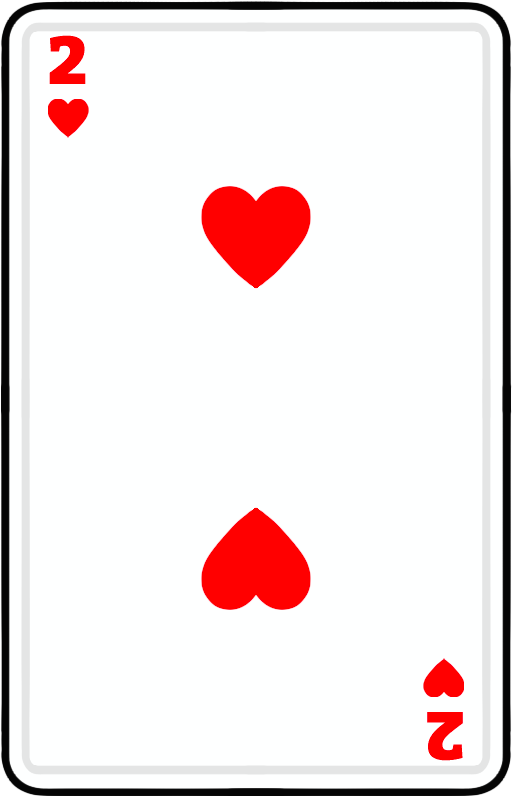
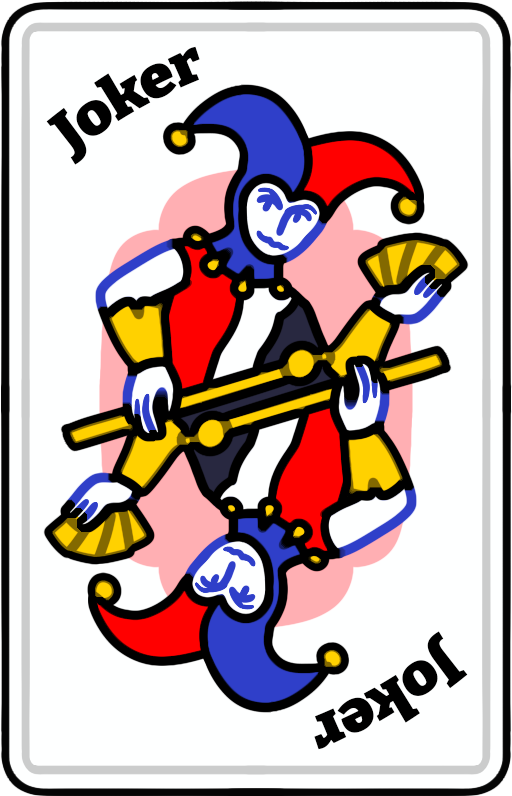
Wild cards are jokers and 2s. Either can substitute for any natural rank in a meld, but two limits hold every time: every meld must contain at least two natural cards, and no meld can contain more than three wild cards. A canasta of seven cards therefore has at least four naturals; a six-card meld has at least three; smaller melds always have at least two.
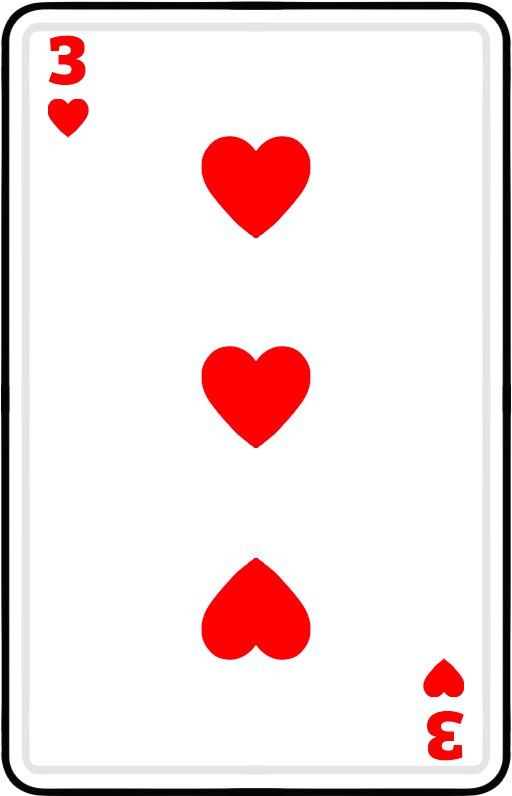
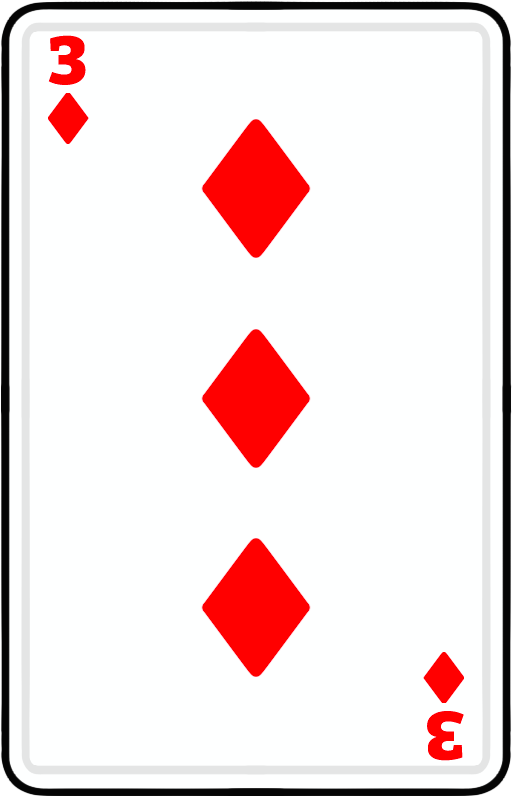
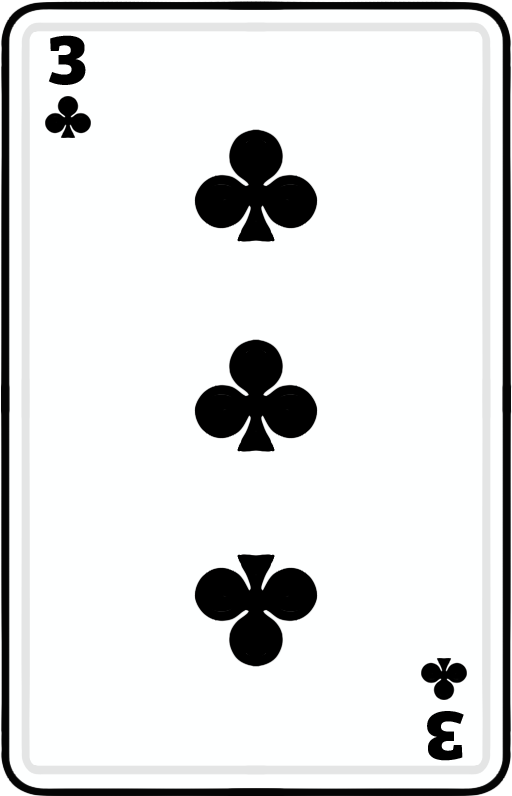
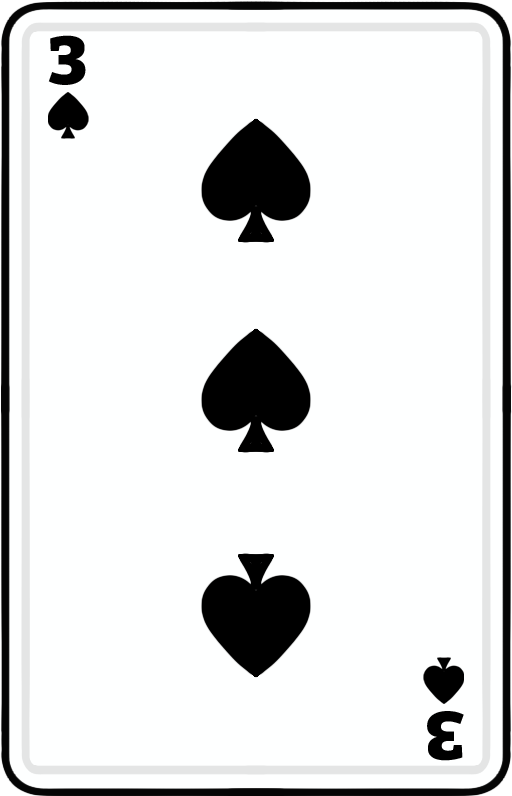
Two ranks have special functions. Red threes are pure bonus cards that sit on the table when drawn. Black threes act as safe discards.
A team goes out by playing every card from a player's hand. The team must have completed at least one canasta first. Going out earns a 100-point bonus, or 200 if the player melds the entire hand in a single turn (going out concealed) without any prior team melds.
Canasta Card Values and Scoring
Each card carries a fixed point value used for both meld scoring and the deadwood penalty at the end of a hand.
- Joker50
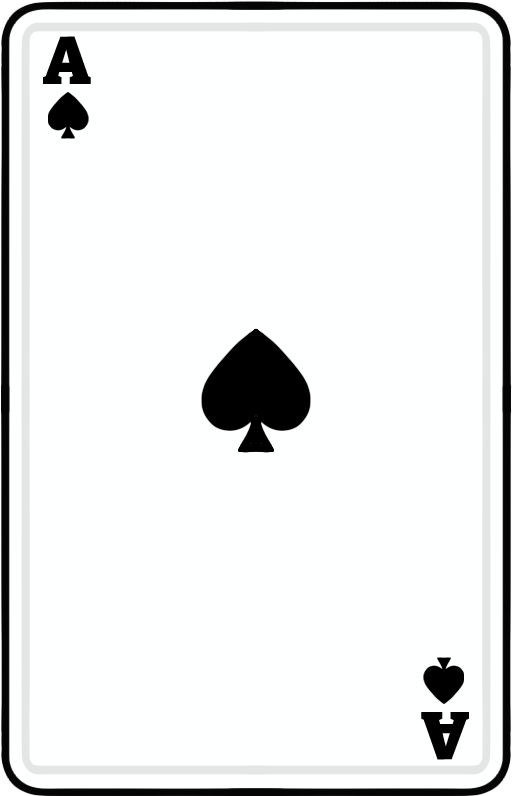 Ace, 2 (wild)20 each
- 8, 9, 10, Jack, Queen, King10 each
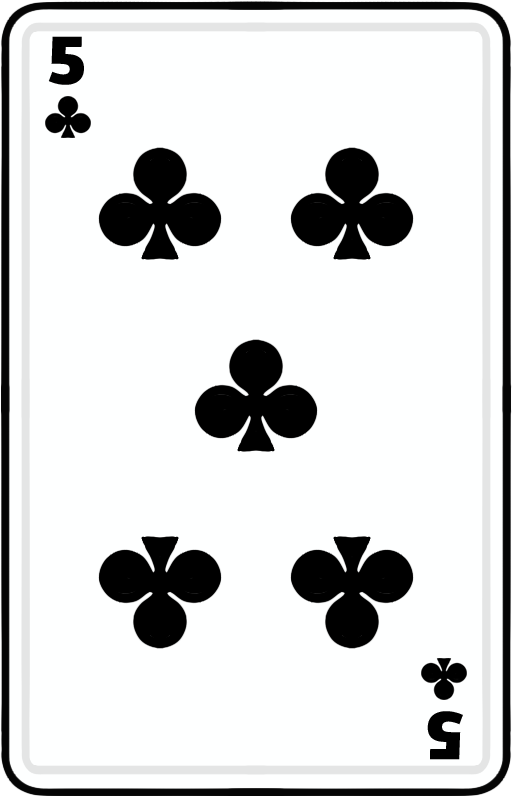 4, 5, 6, 75 each
- Black 35
- Red 3100 (bonus only)
Canastas earn additional bonuses on top of the card values they contain. A natural canasta earns 500. A mixed canasta earns 300. Going out earns 100, or 200 when a player goes out concealed (the entire hand melded in a single turn with no prior team melds).
Red threes function purely as bonus cards. Each red three on the table is worth 100 points if the team has melded at least once that hand. If a team holds all four red threes, the bonus jumps to 800 total. The penalty for failing to meld is severe: each red three becomes minus 100, and minus 800 for all four.
The first meld your team plays each hand must reach a minimum point total based on the team's accumulated score across previous hands. Card values count toward the threshold; canasta bonuses, red-three bonuses, and going-out bonuses do not.
| Cumulative score | Minimum initial meld |
|---|---|
| Negative | 15 points |
| 0 to 1,495 | 50 points |
| 1,500 to 2,995 | 90 points |
| 3,000 or more | 120 points |
At the end of each hand, every card still in a player's hand is subtracted from the team's score at face value. A joker left unmelded costs the team 50 points. A 7 costs 5. Cards already on the table in melds count positively. The team's hand score is the sum of all melded card values, plus canasta and red-three bonuses, plus the going-out bonus (if any), minus the deadwood penalty.
Canasta Strategy: Five Tactics That Win Hands
Strong canasta play decomposes into pile control, wild-card discipline, and score-band management. The discard pile moves the most points: a single take can shift twenty cards from the table to a player's hand. Every other tactic feeds back to who claims the pile or denies it.
1. Meld the minimum number of cards on your initial meld. Players who hit the threshold by a wide margin dump cards they could have used to take the pile later. A first meld of 6-6-6 plus K-K-Joker totals 80 points, comfortably over a 50-point threshold, and keeps any third 6 or third K in hand as future pile-take currency. Stripping more cards than needed is the most common new-player error in the first turn of a hand.
2. Track Aces and 7s with a two-digit count. Mental tally: “X-Y” where X is Aces discarded so far, Y is 7s. Reset to 0-0 whenever a player picks up the pile. Once you see “5-5” (five of each gone), discarding the next Ace or 7 you hold is dangerous: the rank may be locked in your hand or your opponent's pair, and a stranded Ace or 7 costs your team heavily at hand's end.
3. Freeze the pile when behind on pairs. A frozen pile is takeable only by a natural pair from hand. Freeze when your team has fewer pairs than your opponents, when the pile is growing dangerously large for an opponent, or when you hold no useful pairs yourself. Skilled players freeze no more than twice per hand; freezing more often signals you are misreading the value calculus.
4. Discard ranks already canasta'd by either team. Once your team closes a canasta in a rank, that rank stops earning your team anything: a partnership cannot run a second meld of the same rank, so the discard is dead weight to you and cheap to give away. The opposing team can still meld the rank, so check their table first. Dead ranks are the safest discards in the game after black threes. Below them in safety: ranks where five or more copies are visible, low-value 4s through 6s, and mid-rank cards with no public information about opponent holdings.
5. Hold wild cards almost always. In Classic Canasta a discarded wild card freezes the pile, but giving up a 50-point joker or a 20-point 2 just to freeze is rarely the best trade. Save wilds to close mixed canastas, to clear the 120-point threshold once your team passes 3,000, or to go out. The one-wild mixed canasta is the workhorse play: it pays 300 on top of card values, where the same six cards left open pay their face value and nothing else.
The History of Canasta
Canasta was invented in 1939 in Montevideo, Uruguay, at the city's Jockey Club. Segundo Sánchez Santos, a Uruguayan attorney, designed the game with his bridge partner Alberto Serrato, an architect. They wanted a partnership card game shorter than bridge but more strategic than rummy. The name comes from the Spanish word for basket, referring to the small tray used to hold the stock and discard piles during early play.
Through the 1940s the game spread north from Uruguay through Argentina, Chile, Peru, and Brazil. By 1948 it was the dominant card game in the fashionable clubs of Buenos Aires.
Canasta arrived in the United States in 1948 through Alejandro Rosa, an Argentine simultaneous interpreter at the United Nations, who taught the rules to Ottilie H. Reilly, the assistant manager of New York's Regency Hotel. Six days after that lesson, Reilly published a four-page rulebook, the first English-language guide to the game.
The official Argentine ruleset followed in 1949, brought to New York by Josefina Artayeta de Viel and codified at the Regency Whist Club. Oswald Jacoby co-chaired the United States National Canasta Laws Commission, and the New International Canasta Laws appeared in his 1950 book Complete Canasta. Other publishing names of the period included Charles H. Goren, Ely Culbertson, John R. Crawford, Albert H. Morehead, and Geoffrey Mott-Smith.
By the end of 1950, by some accounts ten million Americans were playing. Canasta sets, two decks plus a tray and score pad, reportedly outsold every other toy item in 1951. For a brief stretch, canasta surpassed bridge as the bestselling card game in the country.
The craze faded through the late 1950s as bridge reasserted itself. Canasta has remained a steady presence in card clubs since. The Modern American Canasta variant, codified in 2012 by Sue and Alan Silberstein in South Florida, is the dominant tournament form in the United States today. The Hand and Foot variant, traced to the 1970s United States with branded decks appearing in 1987, is the most-played version at home.
Canasta Variants
Canasta has spawned a family of related games. The most-played variants:
| Variant | Players | Decks | Dealt | Target | Feature |
|---|---|---|---|---|---|
| Classic | 4 (partners) | 2 + 4 jokers | 11 | 5,000 | The 1950s standardised ruleset |
| Modern American | 4 (partners) | 2 + 4 jokers | 13 | 8,500 | Special-hand bonuses, two-canasta go-out |
| Hand and Foot | 4 (partners) | 4 to 6 | 11 + 11 | varies | Each player gets two stacks |
| Samba | 4 (partners) | 3 + 6 jokers | 15 | 10,000 | Sequence melds (runs) score 1,500 |
| Bolivian | 4 (partners) | 3 + 6 jokers | 15 | 15,000 | Wild canasta worth 2,500 (a “bolivia”) |
| Italian | 4 (partners) | 2 + 4 jokers | 11 | 7,000 | Position-based pickup rules |
Classic Canasta is the standardised 1950s ruleset described in this guide. It remains the default version in most card clubs.
Hand and Foot is the most-played canasta variant in North America. Each player is dealt two stacks: the hand (played first) and the foot (played after the hand is exhausted). The variant introduces clean (no wilds), dirty (with wilds), and sometimes wild canastas, each with different bonus values.
Modern American Canasta, codified in 2012 by Sue and Alan Silberstein in South Florida, is the dominant US tournament form. It uses a 13-card deal, requires two canastas to go out, and adds special-hand bonuses (Garbage, Miami Pair, Zip Code) worth 2,000 to 3,000 points. The game ends at 8,500.
Two-Player Canasta
Canasta works for two players with three rule changes. Each player is dealt 15 cards instead of 11. Each turn, the player draws two cards from the stock instead of one (and still discards only one). Two canastas are required to go out, instead of one. Everything else (card values, melds, freezing, scoring, wild cards) matches the four-player partnership rules.
Two-player canasta runs faster than the four-player game and rewards card-counting more heavily, since the smaller hand reservoir makes every discard read more clearly without partner-signal noise.
Frequently Asked Questions
How many decks do you need for canasta?
Two 52-card decks plus four jokers, for 108 cards total. A practical detail: pick decks with matching back designs so a stranded card cannot be identified after the shuffle. Both decks combine into one shared stock pile.
What is a natural canasta?
The 500-point natural canasta beats the 300-point mixed canasta by a wider margin than any other scoring difference in the game. The natural version is seven or more cards of the same rank with no wild cards. Many players mark it on the table by placing a red card on top of the stack.
When is the discard pile frozen?
The discard pile is frozen in three situations: when a wild card (joker or 2) is discarded onto it, when a red three is turned up as the initial face-up card, or against a team that has not yet made its first meld for that hand. A frozen pile can only be taken by holding two natural cards in hand that match the top card of the pile.
How do you score in canasta?
A team's hand score equals the sum of all melded card values, plus bonuses (500 per natural canasta, 300 per mixed, 100 for going out, 100 per red three with 800 for all four), minus the value of cards left in players' hands. The game runs over multiple hands until one team reaches 5,000 points.
Can you go out without a canasta?
No. To go out in canasta, a team must have completed at least one canasta. This rule is what drives the central strategy of the game: even when a player can meld every card in hand, the team cannot end the round until at least one seven-card meld is on the table.
What are red threes in canasta?
Red threes are the 3 of Hearts and 3 of Diamonds. When a player draws a red three, the card is placed face up on the table immediately and a replacement is drawn. Each red three is worth 100 points if the team has melded, or minus 100 if not. All four red threes held by one team count for 800 bonus points (or minus 800 if the team failed to meld).
What are black threes used for?
Black threes (the 3 of Clubs and 3 of Spades) are safe discards. The next player cannot take the discard pile after a black three is played. Black threes cannot be melded during normal play. They can only be played in a meld when a player is going out, and that meld may not include wild cards. Each black three is worth 5 points.
How does the initial meld requirement work?
The first time a team melds in a hand, the cards melded that turn must total at least a minimum point value based on the team's cumulative score: 15 points if negative, 50 from 0 to 1,495, 90 from 1,500 to 2,995, and 120 at 3,000 and above. Only card values count, not canasta or red-three bonuses. Multiple melds played in the same turn can combine to reach the threshold.
Can you play canasta with 2 players?
Yes. Two-player canasta deals 15 cards each instead of 11, requires drawing two stock cards per turn instead of one, and requires two canastas to go out instead of one. All other rules match the four-player partnership game. See our two-player canasta page for the complete rules.
Where did canasta originate?
Canasta was invented in 1939 in Montevideo, Uruguay, at the Jockey Club, by Segundo Sánchez Santos, an attorney, and his bridge partner Alberto Serrato, an architect. They designed it as a partnership card game shorter than bridge but more strategic than rummy. The name comes from the Spanish word for basket, referring to the table tray used to hold the stock and discard piles.
Play Canasta Online
Play canasta free against AI partners and opponents, or invite friends through a private match link. Daily challenges deal the same starting hand to every player so you can compare scores against the global leaderboard. Matchmaking pairs you with players of similar skill for ranked games when no friend is at the table.
Daily Canasta Challenge · Canasta Glossary · Canasta Strategy