


What Is Mahjong Solitaire?
Mahjong Solitaire is a one-player tile-matching game played with the 144 tiles of a mahjong set. It is not the four-player game of mahjong: there are no turns, no hands, and no opponents. Every tile starts face up in a stacked layout, and you clear the layout by removing matching pairs of free tiles.
A tile is free when nothing sits on it and its left or right side is open. Take away all 72 pairs to win. If you run out of free pairs with tiles still standing, the deal is over. The game is also called Shanghai, after the 1986 computer version, and its traditional layout is the Turtle.
- Players: one
- Tiles: 144, in 42 different faces
- Goal: remove every tile, two at a time
- Free tile: nothing on top, and the left or right side open
- Layouts here: Turtle, Pyramid, Fortress, and Cross
- Other names: Shanghai, Taipei, Kyodai, and the Turtle
How to Play Mahjong Solitaire
Every move removes two matching free tiles. Nothing else ever happens: no tiles are drawn and none are added, so the board only gets smaller.
- Find the free tiles. A tile is free when no tile lies on it, even partly, and its left side or its right side is clear. Only free tiles can be picked. In our game, free tiles are bright and blocked tiles are dimmed.
- Pick two matching free tiles. Click or tap one free tile, then a free tile with the same face. The pair leaves the board. A blocked tile will not select, and two different tiles will not pair.
- Match flowers and seasons by group. Any flower matches any other flower, and any season matches any other season. Every other tile needs its exact twin: a 3 of Bamboo pairs only with another 3 of Bamboo.
- Work down the stack and in from the ends. Each pair you remove can free the tiles it covered or pressed against. Clear the high layers and the ends of the rows to open the tiles beneath and between.
- Clear all 144 tiles to win. The deal is won when the board is empty, after 72 pairs. It ends when tiles remain but no two free tiles match.
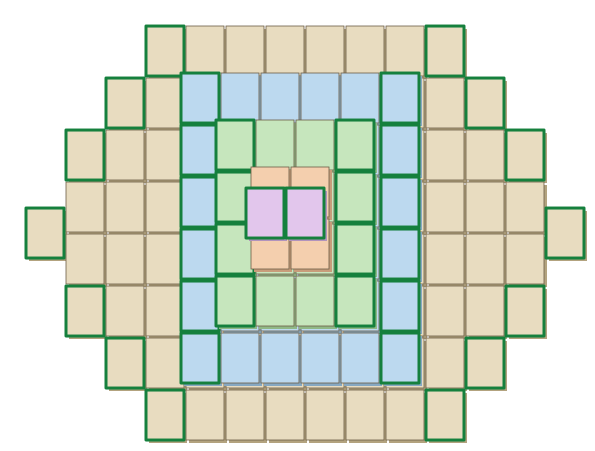
Which tiles are free?
Two tests decide it, and a tile has to pass both. First, no tile may lie on it, and a partial overlap counts. The two tiles on top of our Turtle each half-cover two of the four tiles beneath them, so each of those four stays blocked until the top tile over it is gone.
Second, the tile must be able to slide out sideways: its left side or its right side has to be clear. In a row, only the two end tiles can pass, and the rest open one at a time as you take tiles off either end. A tile set half a row down counts against both rows it touches. Our Turtle has one such tile jutting out at each end of its bottom layer, and each blocks the end tiles of the two middle rows. That leaves the bottom layer with just 14 free tiles at the start: the two ends of its six other rows, plus the two jutting tiles.
The 144 Mahjong Tiles and Which Ones Match
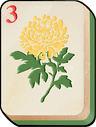
The set holds 42 different faces. Thirty-four of them come four times each: three suits numbered 1 to 9 (Dots, Bamboo, and Characters), four winds, and three dragons. The other eight are single tiles, four flowers and four seasons, and they are the only tiles that match something other than their exact twin.
| Group | Faces | Tiles |
|---|---|---|
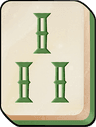
| Dots also called Circles or Coins; 1 to 9 |          | 36 (four of each) |
| Bamboo also called Sticks; 1 to 9 |          | 36 (four of each) |
| Characters also called Cracks; 1 to 9 |          | 36 (four of each) |
| Winds North, South, East, West |     | 16 (four of each) |
| Dragons Red, Green, White |    | 12 (four of each) |
| Flowers Plum, Orchid, Chrysanthemum, Bamboo |     | 4 (one of each) |
| Seasons Spring, Summer, Autumn, Winter |     | 4 (one of each) |
| Total | 42 faces | 144 |
The 1 of Bamboo is drawn as a bird, not a stick. Each Characters tile shows a Chinese numeral above the character wan, meaning ten thousand. The Red Dragon is the character zhong (middle), and the White Dragon is an empty frame.


Mahjong Solitaire Layouts: Turtle, Pyramid, Fortress, and Cross
Every layout uses all 144 tiles; what changes is how high they stack, how long the rows run, and how many tiles are free at the start. The layout picker under the board marks each one with one to three stars, and switching layouts deals a new game.
| Layout | Stars | Tiles per layer, bottom up | Free at the start | Deals our solver cleared |
|---|---|---|---|---|
| Pyramid | 1 | 72, 42, 20, 6, 4 | 46 | Every deal, by design |
| Turtle | 2 | 86, 36, 16, 4, 2 | 36 | All 10,000 tested |
| Cross | 2 | 68, 40, 20, 16 | 40 | Every deal, by design |
| Fortress | 3 | 96, 32, 12, 4 | 34 | 977 of 1,000 |
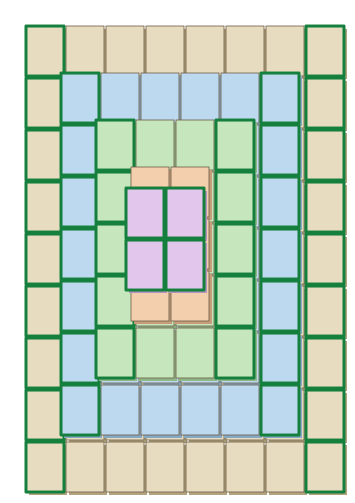
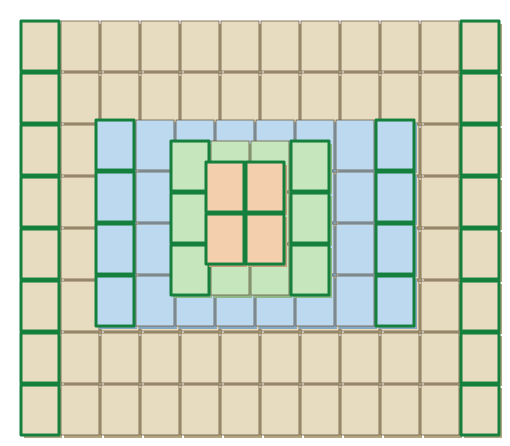
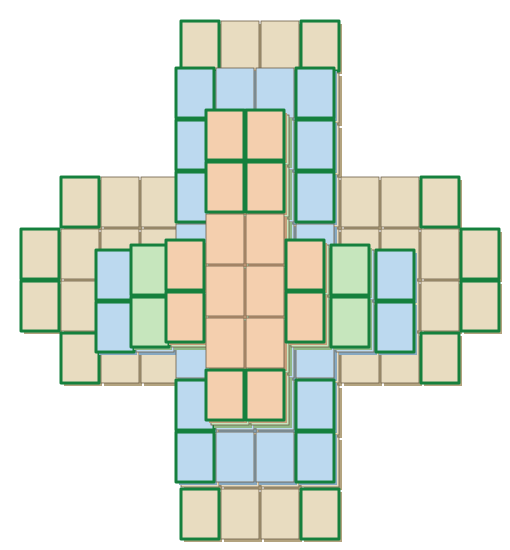
Colors mark the layers, sand at the bottom, then blue, green, orange, and violet; green outlines mark the tiles that are free when a deal starts.
Pyramid is the gentlest: 46 free tiles to start and a bottom layer whose rows are only 8 tiles long. Turtle is the traditional shape, a raised shell with tiles jutting out at both ends. Ours is close to the classic Turtle but not a copy: the classic has 87 tiles on the bottom and 1 on top, ours 86 and 2. Cross is a plus sign four layers deep, with 16 tiles on its top layer. Fortress earns its three stars: 96 tiles on the bottom in rows of 12, and only 34 free at the start.
Mahjong Solitaire Strategy: The Trick to Clearing the Board
Removing a tile never blocks another tile; it can only free them. So the order of your moves barely matters, and the only decision that can lose a deal is which copies of a face you pair together (a shuffle aside). Most faces come four times, and four tiles split into two pairs in three different ways. Once the pairing is right, any order of moves clears the board. The tips below are about choosing that pairing well.
Take tiles off the top of the stack first
A tile on a high layer holds down everything under it, and those tiles stay out of reach until it goes. Clearing the peak early also shows you what the lower layers hold, so your pairing choices are made with more faces in view. Grabbing the easy pairs along the bottom edge first is the quickest way to run dry. On Fortress, whose bottom rows are 12 tiles long, work the ends of the long rows as well as the top.
Never leave two copies stacked on each other
Two copies of a face where one lies above the other can never be matched with each other, because the lower one stays covered until the upper one has gone. Each of them has to pair with one of the other two copies. In 674 of 1,000 Turtle deals from our game, at least one face has one copy somewhere above another, so this comes up in most games.
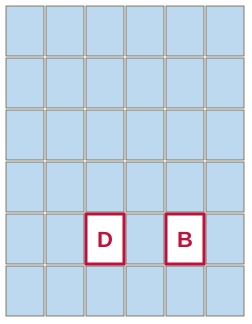
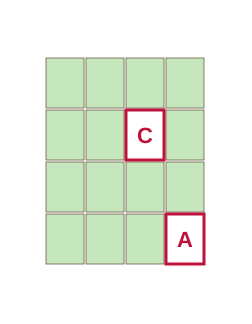
In this deal, Dragon A is free from the first move, and it sits directly on Dragon B. Dragon C is under one of the four tiles below the top pair, and Dragon D is under a layer-3 tile. Pair C with D and the deal is lost on the spot: A and B are the last two Red Dragons, and B cannot come free while A is on it. Pair A with C and B with D, and the deal clears: that is the pairing our solver used to win it.
With three copies free, keep the one that blocks nothing
When three copies of a face are free, look for one that has no tile under it and no tile pressed against its side. Leave that one and take the other two: the copy you keep can wait for the fourth without holding anything up, so taking the pair now costs nothing. If all three block something, find the fourth copy first and pick the pair that frees the most.
Break ties by what the pair uncovers
When two pairs are equally safe, take the one that frees more tiles. More free tiles means more faces in view and more choices on the next move. The Pairs counter above the board shows how many free pairs you have right now.
Use Undo to look ahead, and Shuffle to get unstuck
Undo steps back one match at a time, so you can take a pair, see what it uncovers, and put it back. Shuffle deals the remaining faces onto the same spots at random, as often as you like and even after No More Matches: if the new faces make a free pair, the game carries on. It can also turn a winnable board into one that cannot be won, so when you know which pairing went wrong, Undo is the better way back.
Can Every Mahjong Solitaire Game Be Won?
Nearly every game on this page can. Our solver, which sees every tile including the ones hidden under others, found a winning line for all 10,000 Turtle deals we tested, and each line was replayed move by move through the game's own rules. Pyramid and Cross go further: our deal generator places each pair so that removing the pairs in the order it placed them is always legal on those two layouts, so every Pyramid and Cross deal can be cleared.
Fortress is the exception: the solver cleared 977 of 1,000 Fortress deals and could not settle the other 23 either way, so a Fortress deal you cannot finish may be one that nobody could.
Deals built at random fare worse: Michiel de Bondt's solver checked 10 million classic Turtles with the tiles placed at random and found that about 3 in 100 cannot be cleared, even by a player allowed to look under every tile. Our generator does not place tiles at random: it fills the layout pair by pair, both tiles of a pair on the same layer, from the top of the stack down and from the outside in. A winnable deal is still not a promise: you cannot see the faces under the top tiles, and one wrong pairing can end it. A shuffle lays the faces out at random, so a shuffled board may not be winnable at all.
Mahjong Solitaire vs Mahjong
They share a tile set and a name, and that is all. Mahjong is a four-player game from 19th-century China: players draw and discard tiles to build a winning hand. Mahjong Solitaire is a matching puzzle for one person, first put on a computer in 1981.
| Mahjong Solitaire | Mahjong | |
|---|---|---|
| Players | One | Four |
| Tiles | 144, all face up in a stacked layout | Dealt into hidden hands; most sets hold 144, some more |
| A turn | Remove two matching free tiles | Draw a tile, then discard one |
| Goal | Clear the board | Complete a winning hand first |
| Origin | First computer version 1981; earlier history unknown | China, 19th century |
If you like clearing a stacked layout in pairs, Pyramid Solitaire does it with cards: pairs that add up to 13, taken from a pyramid of 28. The board games page lists our other tile and board games.
Where Mahjong Solitaire Came From
The first computer version of Mahjong Solitaire dates from 1981, and nothing firm is known about the game before that. Brodie Lockard, a Stanford gymnast paralyzed in a trampoline accident, learned a 144-tile layout called the Turtle from hospital staff, who played it with real tiles. He programmed it on the PLATO system, typing with a stick held in his mouth, and called it Mah-Jongg. Players touched the tiles on the screen to pick them.
Activision published Lockard's game as Shanghai in July 1986 and sold it as a centuries-old Chinese game called the Turtle, a claim Lockard never made. Microsoft put its own version, Taipei, in the first Microsoft Entertainment Pack for Windows in 1990; it came back as Mahjong Titans in Windows Vista and Windows 7, and as Microsoft Mahjong from Windows 8 in 2012.
The Turtle is still the standard layout. The classic version, as the long-running open-source games ship it, stacks 87, 36, 16, 4, and 1 tiles from the bottom up.
Mahjong Solitaire FAQ
What is the trick to Mahjong Solitaire?
Pair the right copies. Removing tiles never blocks anything, so the order of your moves matters far less than which copies of a face you match together. Clear the top of the stack first, never leave two copies stacked on each other, and when three copies are free, keep the one that blocks nothing.
What is the difference between Mahjong Solitaire and regular mahjong?
Mahjong Solitaire is a one-player matching puzzle: all 144 tiles start face up in a stacked layout, and you remove them in pairs. Regular mahjong is a four-player game from 19th-century China in which players draw and discard tiles to build a winning hand. The two games share the tiles and nothing else.
How is Mahjong Solitaire scored?
The standard rules have no points: you clear the board or you do not. Some programs add points for each pair and bonuses for chains, runs of quick matches. Our game keeps no score. It shows the tiles left, the free pairs, and a timer, and a win reports your moves and your time.
How many tiles are in Mahjong Solitaire?
There are 144. Three suits, Dots, Bamboo, and Characters, run from 1 to 9 with four copies of each, which makes 108 tiles. Add 16 winds, 12 dragons, 4 flowers, and 4 seasons. Every layout on this site uses all 144 tiles, so a win takes 72 pairs.
How do flower and season tiles match?
Any flower matches any other flower, and any season matches any other season, even though all eight tiles look different. A flower never pairs with a season. Every other tile needs its exact twin, so the Red Dragon pairs only with another Red Dragon and a 3 of Bamboo only with a 3 of Bamboo.
What makes a tile free in Mahjong Solitaire?
Two things: no tile lies on it, even partly, and its left side or its right side is open. The top and bottom edges do not count. A tile squeezed between neighbors on both sides stays blocked until one of them goes. In our game, blocked tiles are dimmed and will not select.
Is every game of Mahjong Solitaire winnable?
Not always, but ours nearly always are. Our solver cleared all 10,000 Turtle deals it tried, and every Pyramid and Cross deal can be won by design. Fortress is the hard one: 977 of 1,000 cleared. With tiles placed at random, about 3 in 100 classic Turtles cannot be won.
What is turtle mahjong?
The Turtle is the traditional Mahjong Solitaire layout: 144 tiles stacked into a raised shell, with tiles jutting out at both ends of the bottom layer. The classic Turtle has five layers of 87, 36, 16, 4, and 1 tiles. Our game opens on its own Turtle, with 86 tiles on the bottom and two on top.
How to play turtle with mahjong tiles?
Use a full 144-tile set, including the eight flower and season tiles, and build the Turtle face up: 87 tiles on the bottom layer, then 36, 16, and 4, with one tile on top. Then remove matching pairs of free tiles by the same rules as on screen until the table is clear or no pair is left.
What happens when no more matches are available?
The game stops and shows No More Matches, with the clock paused. You still have three ways out: Undo steps back so you can pair different copies, Shuffle deals the remaining faces onto the same spots and can reopen the board, and New Game starts over. Two tiles stacked on each other stay stuck whatever the shuffle.
Can you undo moves in Mahjong Solitaire?
Yes. Undo takes back your last match, and each press steps back one more, including a shuffle. Use it to test a pairing: match two tiles, see what they uncover, and step back if you do not like it. There is no penalty for undoing, because our game keeps no score.
Who invented Mahjong Solitaire?
Nobody knows who first played it with real tiles. Brodie Lockard wrote the first computer version, Mah-Jongg, on the PLATO system in 1981, after hospital staff taught him a tile layout called the Turtle while he recovered from a gymnastics accident. Activision released his game as Shanghai in 1986.
Can I play Mahjong Solitaire free without downloading?
Yes. The game at the top of this page is free, runs in the web browser on a computer, tablet, or phone, and needs no download and no sign-up. It has four layouts, unlimited hints, shuffle, and undo, and it saves an unfinished game in your browser so you can come back to it.
Play Mahjong Solitaire Free Online
The game at the top of this page is free, runs in any web browser, and needs no download and no sign-up. Here is exactly what it does:
- Four layouts: Turtle, Pyramid, Fortress, and Cross, picked under the board. The game remembers your choice.
- Hint lights up one free pair, as often as you like.
- Shuffle lays the remaining faces out again at random, even after No More Matches. It is not counted as a move, and Undo can take it back.
- Undo steps back one match at a time.
- Zoom: the minus and plus buttons under the board make the tiles bigger on a phone, and you drag to move around the board.
- Theme changes the tile style and the background.
- No score: the bar above the board shows tiles left, free pairs, and a timer, and a win shows your moves and time.
- Saved as you go: an unfinished game waits in this browser for your next visit.
If you are new to the game, start on the Pyramid. It opens with 46 free tiles, the most of the four layouts, and every Pyramid deal can be cleared.