

Euchre Rules
Under standard euchre rules, the goal is to be the first team to 10 points: 4 players in two partnerships play hands of five tricks with a 24-card deck, and the team that picks trump, the makers, must take at least 3 of the 5 tricks to score. The euchre card game rules below follow the standard North American game and flag each point where tables split. Our game plays them with you and a computer partner against two computer opponents.
Quick Reference
These 10 rules of euchre cover a whole game.
| # | Rule | Standard game |
|---|---|---|
| 1 | Players | 4, in two partnerships; partners sit opposite |
| 2 | Deck | 24 cards: the 9, 10, Jack, Queen, King, and Ace of each suit |
| 3 | Deal | 5 cards each; the other 4 form the kitty, with the top card turned face up |
| 4 | Making trump | Up to two rounds from the dealer's left: accept the up-card's suit, then name another |
| 5 | Trump ranking | Right bower, left bower, Ace, King, Queen, 10, 9 |
| 6 | Following suit | Follow the suit led if you can; the left bower counts as a trump |
| 7 | Winning a trick | The highest trump, or if no trump is played, the highest card of the suit led |
| 8 | Makers need | At least 3 of the 5 tricks |
| 9 | Points | 1 for 3 or 4 tricks, 2 for a march, 4 for a loner march, 2 to the defenders for a euchre |
| 10 | Game | First team to 10 points |
One Hand, Step by Step
Here is how to play euchre, one hand from shuffle to score. The how to play summary on the main euchre page gives the short version.
- Deal 20 cards and build the kitty. The dealer shuffles the 24 cards and gives each player 5, clockwise from the left. The last 4 form the kitty, and the dealer turns its top card face up as the up-card.
- Accept or refuse the up-card's suit. In round one, each player from the dealer's left passes or takes that suit as trump. Once anyone accepts, the dealer adds the up-card to their hand and discards one card face down.
- Name another suit if all four refuse. The up-card's suit is then out. In round two each player, again from the dealer's left, may name one of the other three suits or pass. If all four pass again, the hand is thrown in; under stick the dealer, which our game always plays, the dealer must name a suit.
- Decide whether to play alone. The player who fixed trump may play the hand without a partner, who puts their five cards away unseen until the next deal.
- Lead the first trick. The player on the dealer's left leads any card, or the next player if that seat is sitting out for a loner.
- Follow suit and win tricks. Each player must follow the suit led if possible, counting the left bower as a trump. A trick goes to its highest trump; with no trump in it, the top card of the suit led takes it, and that player leads the next trick.
- Score and move the deal. The makers score 1 point for 3 or 4 tricks and 2 for all five (4 alone); held to 2 or fewer, they are euchred and the defenders score 2. Then the next player on the left deals, and hands continue until one team has 10.
The Cards and Their Ranking
Euchre card ranking changes the moment trump is fixed: the Jack of the trump suit becomes the highest card in the deck, and the other Jack of the same color becomes the second highest.
How Many Cards in a Euchre Deck
Euchre is played with 24 cards, six ranks in each of the four suits: 9, 10, Jack, Queen, King, and Ace. To make a euchre deck, strip a standard 52-card pack of every card from 2 to 8; North American euchre uses no jokers.
Other packs exist, and our game uses none of them:
- 25 cards: British euchre adds one Joker, the Benny or best bower, which outranks every trump.
- 28 cards: the 24 plus the four 8s, with the 7s left out.
- 32 cards: the 24 plus the 7s and 8s, the usual pack in New Zealand.
The variants page covers the British game.
The Trump Suit
Once trump is made, the trump suit holds 7 cards: the right bower (the Jack of trump), the left bower (the Jack of the other suit of the same color), then the Ace, King, Queen, 10, and 9. With hearts as trump, the Jack of diamonds is the left bower; with spades, the Jack of clubs.
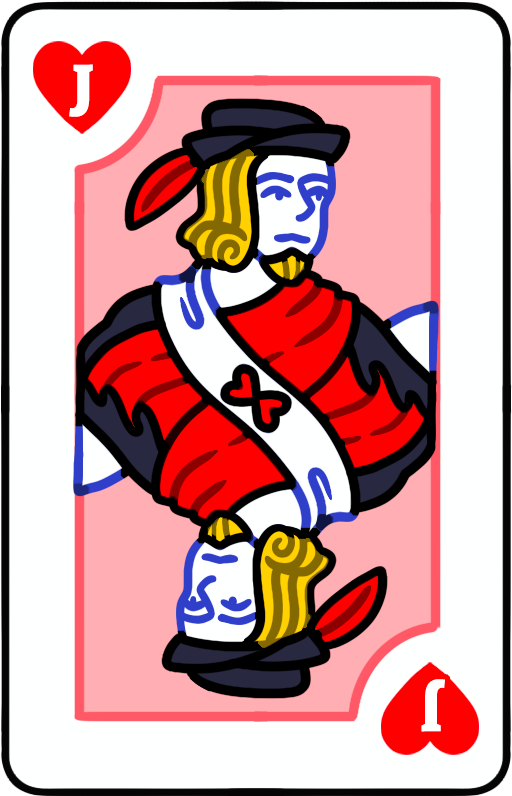
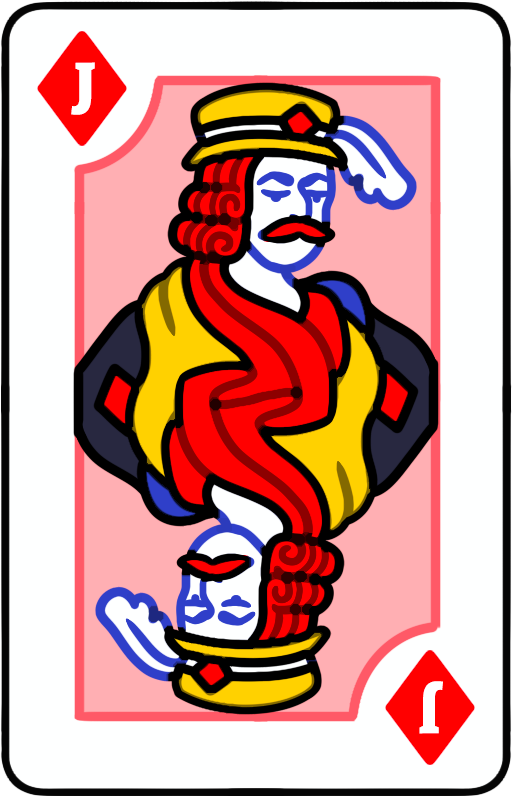
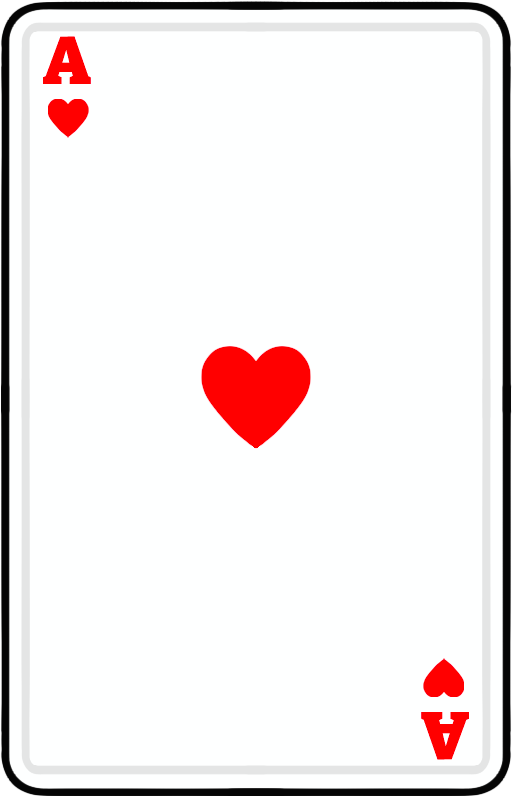
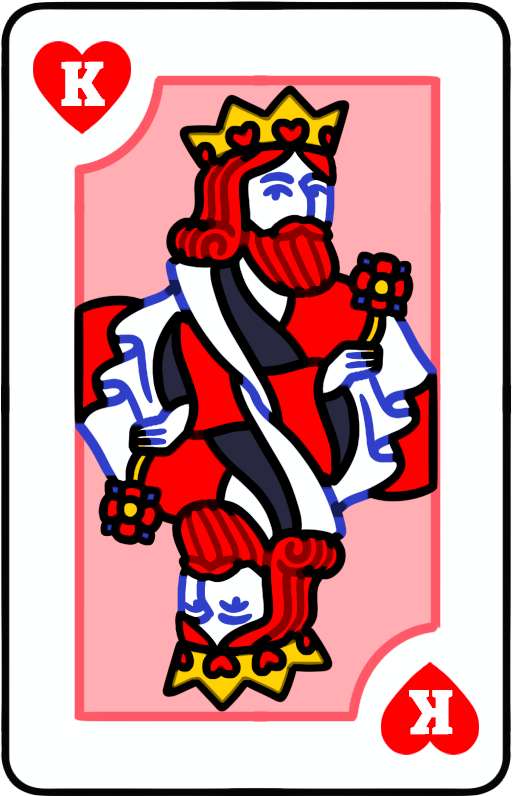
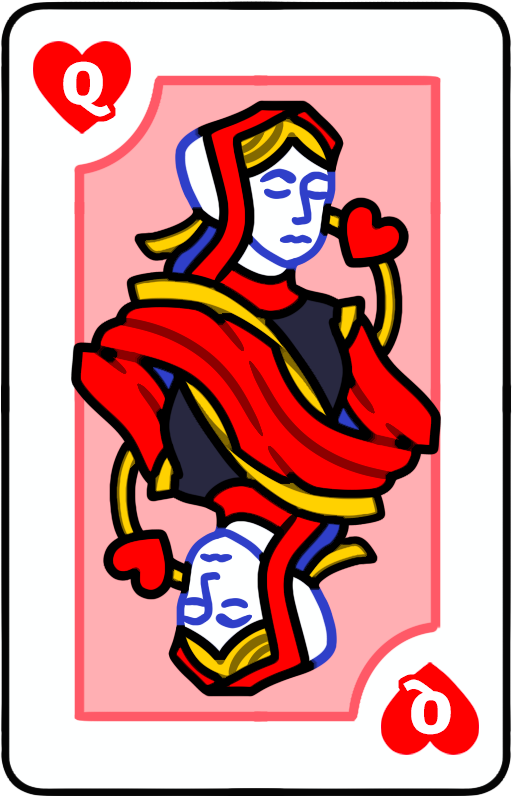
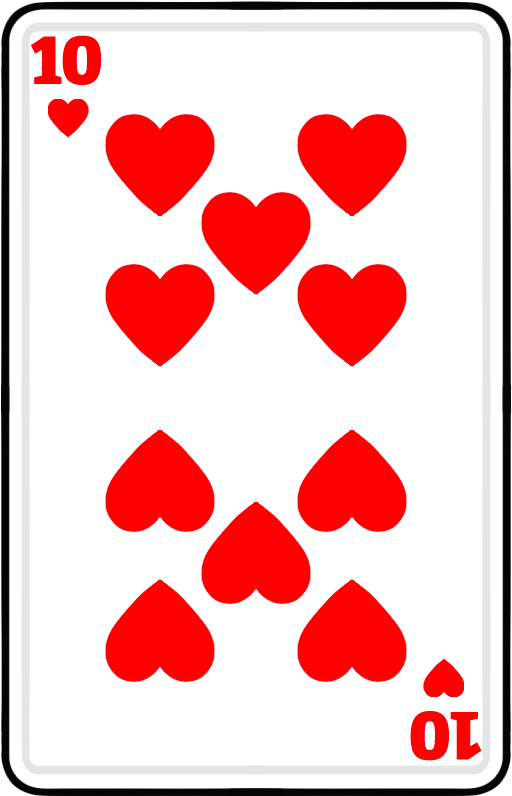
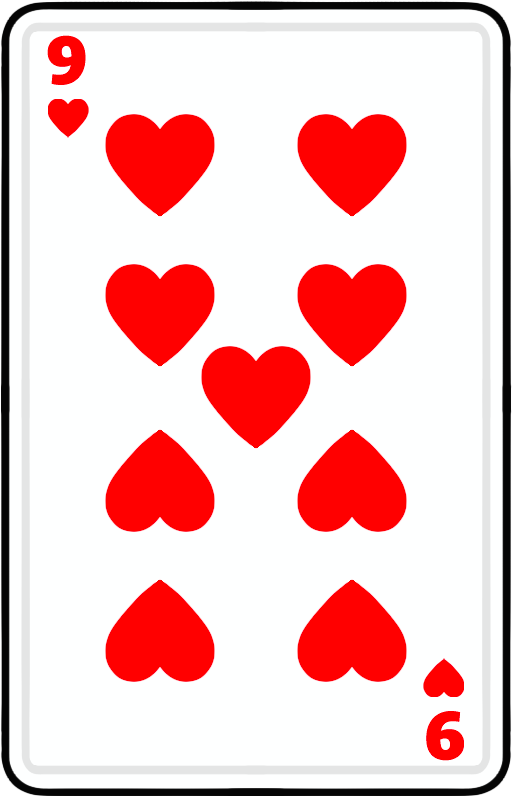
The left bower is a trump for the whole hand, for following suit as well as for winning tricks. This is the rule that trips up beginners, and the section on playing the tricks shows the trap.
The Plain Suits
The three suits other than trump rank Ace, King, Queen, Jack, 10, 9, except that the suit sharing trump's color has lost its Jack. With hearts as trump:
| Suit | Role | Cards, high to low | Count |
|---|---|---|---|
| Hearts | Trump | Jack of hearts, Jack of diamonds, Ace, King, Queen, 10, 9 | 7 |
| Diamonds | Same color as trump | Ace, King, Queen, 10, 9 | 5 |
| Clubs | Other color | Ace, King, Queen, Jack, 10, 9 | 6 |
| Spades | Other color | Ace, King, Queen, Jack, 10, 9 | 6 |
| Total | 24 |
7 + 5 + 6 + 6 = 24. No card leaves the game; one Jack changes suits.
Seating and Dealing
Euchre rules for 4 players seat partners opposite each other, so the teams alternate around the table. Euchre dealing rules then settle who deals first and how the cards go out.
The first dealer. At a table, players often deal cards face up until someone gets a black Jack, and that player deals. Other groups draw from a spread pack and the lowest card deals, Ace low; championship rules break a tie by suit, spades highest, then hearts, diamonds, and clubs. You deal first here, with no draw.
The shuffle and cut. The dealer shuffles and offers the cut to the player on their right. Our game skips the cut.
The deal. Going clockwise from the dealer's left, each player gets 5 cards in two rounds, in packets of 3 and 2: a player given 3 in the first round gets 2 in the second, and the other way round. Stricter rules forbid changing the pattern once it starts, and the World Euchre Championship allows only four: 2s then 3s, 3s then 2s, 3-2-3-2, or 2-3-2-3. Some groups, especially in Canada, deal one card at a time instead. We deal one card at a time; most tables deal packets of 3 and 2. Each player still gets five cards.
The kitty and the up-card. The hands take 20 cards. The last 4 go face down as the kitty, and the dealer turns the top one face up as the up-card: 20 + 4 = 24. The three cards under it stay unseen all hand.
The seats. First seat is the dealer's left, and that player speaks first in both rounds and leads the first trick. Second seat is the dealer's partner, and third seat is the dealer's right. The deal passes one seat to the left each hand, so in our game you deal hand 1, then sit third seat, second seat, and first seat in hands 2, 3, and 4.
Making Trump
Trump is made in up to two rounds, each starting with first seat, and whoever fixes it makes their team the makers.
Round One: The Up-Card
Each player in turn passes or accepts the up-card's suit. The words depend on the seat: an opponent of the dealer orders it up, the dealer's partner says "I assist", and the dealer picks it up. Whoever accepts, the dealer adds the up-card to their hand and discards one card face down, so ordering up hands the dealer a trump. If all four pass, the dealer turns it down, and that suit is out for the hand.
Round Two: Naming a Suit
Starting from first seat again, each player may name one of the other three suits as trump, or pass. Nobody picks up the up-card in round two.
The other suit of the same color as the turned-down card is next: if the King of hearts is turned down, diamonds is next. Either suit of the other color is green, and naming one is called crossing; when the dealer's partner does it, players call it reverse next. The strategy guide covers when each call pays, and the euchre glossary defines the rest of the table slang.
When Everyone Passes Twice
If all four pass again, tables use one of two rules:
- Redeal: the cards are thrown in and the deal passes to the left. Many printed rulebooks give this rule.
- Stick the dealer, also called screw the dealer: the dealer may not pass in round two and must name a suit.
Stick the dealer is a common house rule, used in the World Euchre Championship and many league rule sheets. Our game always sticks the dealer, so every hand is played.
Going Alone
A maker who goes alone plays without a partner and scores 4 points for all five tricks instead of 2.
Only the player who makes trump can go alone. In this game that is always you; the computer players never call a loner. You press Alone as you order up or name trump; some tables allow the call later, after trump is made but before the first lead. The partner lays their cards face down, passes no cards, and sits out, so each trick has 3 cards.
Scoring. All five tricks alone score 4 points, and 3 or 4 tricks score 1. A loner who is euchred gives the defenders 2 points; some tables make it 4.
The opening lead. In our game the player on the dealer's left leads; if that player is sitting out, the dealer's partner leads, the rule some printed rulebooks use. Many tables let the player on the loner's left lead instead. The two rules agree only when the dealer goes alone. A loner on the dealer's left leads the first trick under our rule, and never does under the other.
The dealer still picks up. In our game the dealer picks up and discards when a player orders up alone, even when the dealer is the loner's partner and then sits out.
House rules we do not use. Some tables let a defender go alone too, scoring 4 for a euchre; defending alone is a house rule this game does not use. Under the Canadian loner rule, played in Canada, Britain, and Australia, a dealer's partner who orders up in round one must go alone. Here the dealer's partner may order up and play normally.
Playing the Tricks
Every player must follow the suit led if they can, and the left bower counts as a trump, not as a card of its printed suit.
The first lead can be any card, and play goes clockwise. A player who cannot follow suit may play any card: a trump to win the trick, or a card of another suit to throw away. The highest trump wins. If nobody trumps, the highest card of the suit led wins, and a card of any other suit cannot win however high it ranks. The winner leads the next trick.
The left bower catches players both ways.
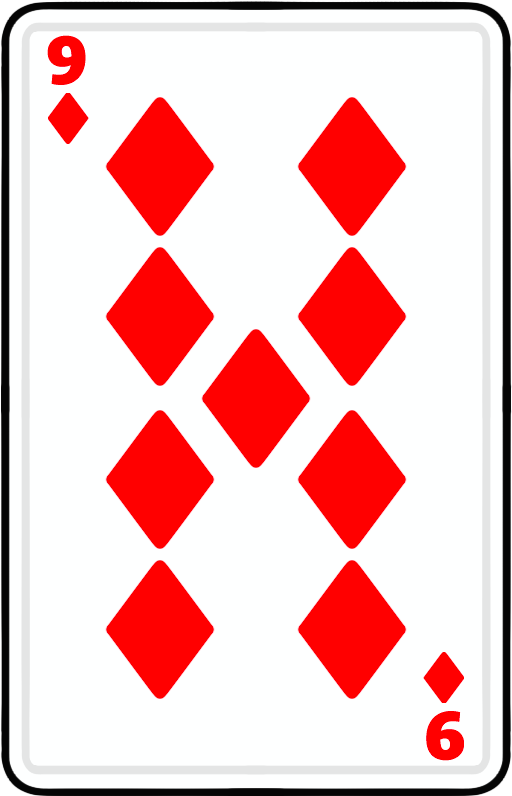
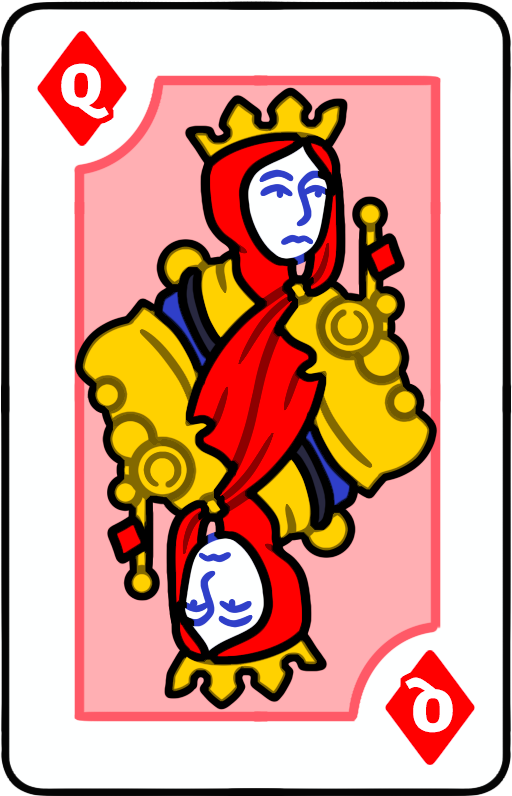
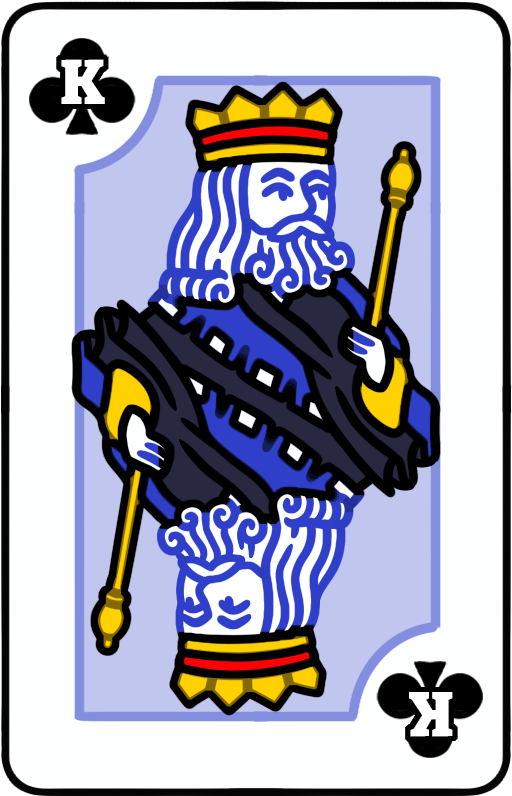
Turn it around. With hearts as trump and the 10 of hearts led, a hand of the Jack of diamonds, the Ace and King of clubs, and the 9 of spades must play the Jack of diamonds, its only trump. Holding it back is a renege.
The left bower wins as a trump, too. With hearts as trump, the Jack of diamonds beats the Ace of diamonds on a diamond lead. With spades as trump, the Jack of clubs, played by someone with no hearts, takes a trick led with the Ace of hearts.
Scoring
Euchre scoring rules give points to one team per hand: the makers if they take 3 or more tricks, the defenders if they hold the makers to 2 or fewer.
| Result | Makers' tricks | Points |
|---|---|---|
| Makers take 3 or 4 tricks | 3 or 4 | 1 to the makers |
| Makers take all five (a march) | 5 | 2 to the makers |
| Loner takes 3 or 4 tricks | 3 or 4 | 1 to the makers |
| Loner takes all five | 5 | 4 to the makers |
| Makers are euchred, with or without a loner | 0 to 2 | 2 to the defenders |
The euchre point system pays the defenders 2 whether they take 3, 4, or 5 tricks. Two house rules raise it to 4: some tables pay 4 for euchring a loner, others for a super-euchre, when the makers take no tricks at all. Our game pays 2 in both cases.
The target. Euchre points count toward 10 in North America, and in our game. Britain usually plays to 11, Wisconsin tables play to 11 more often than not, and 11 is common in Australia and New Zealand. Older American rules played to 5, some groups agree on 5 or 7, and some leagues in Cornwall and the Channel Islands play to 15 or 21. The history of euchre traces the older game.
The finish. The game ends when a team reaches 10 or more after a hand, so a team on 9 that marches alone finishes on 13. There is no need to win by two. A team on 9 is in the barn.
Keeping Score with Two Cards
At the table, each team keeps score with two low cards left over from stripping the pack, and the pips showing give the score:
| Cards | Where and when |
|---|---|
| A 6 and a 4 | Ohio and Indiana |
| Two 5s, one team red, one black | Canada, Michigan, and Nebraska |
| The 2 and 3 of one suit | Western New York and Ontario |
| A 5 and a 6 | Britain and Wisconsin, for games to 11 |
| A 3 and a 4 | Games to 5 |
The usual method starts with one card face up and the other face down on top of it. For each point, slide the top card to uncover one more pip on the bottom card. When the bottom card's pips run out, flip the top card face up and count the pips on both. In Ohio and Indiana the 4 traditionally sits on top of the 6.
The 2 and 3 work differently. The pips showing count 1 to 4; at 5 the cards are turned over and crossed, and from 6 to 9 the pips showing are added to that 5.
Our game keeps score on screen.
A Full Hand, Played Out
This hand, dealt and played through our game's engine, shows a made hand worth 1 point. You deal; West sits on your left in first seat, North is your partner, and East is on your right.
| Seat | Cards |
|---|---|
| You (dealer) | Jack of diamonds, Ace of hearts, Ace of clubs, 9 of clubs, 10 of spades |
| West (first seat) | Jack of hearts, 9 of hearts, Queen of spades, King of spades, 9 of diamonds |
| North (partner) | Queen of hearts, Ace of spades, King of diamonds, Queen of diamonds, 10 of clubs |
| East (third seat) | 10 of hearts, Ace of diamonds, 10 of diamonds, Jack of spades, King of clubs |
| Kitty | King of hearts (the up-card), Jack of clubs, Queen of clubs, 9 of spades |
5 + 5 + 5 + 5 + 4 = 24, with 6 cards of each suit.
Making trump. West, North, and East pass. You pick it up, so hearts are trump and your team are the makers. You take the King of hearts and discard the 10 of spades, which leaves you void in spades. Your hand is now the left bower, the Ace and King of hearts, and the Ace and 9 of clubs: three trumps and an off-suit Ace.
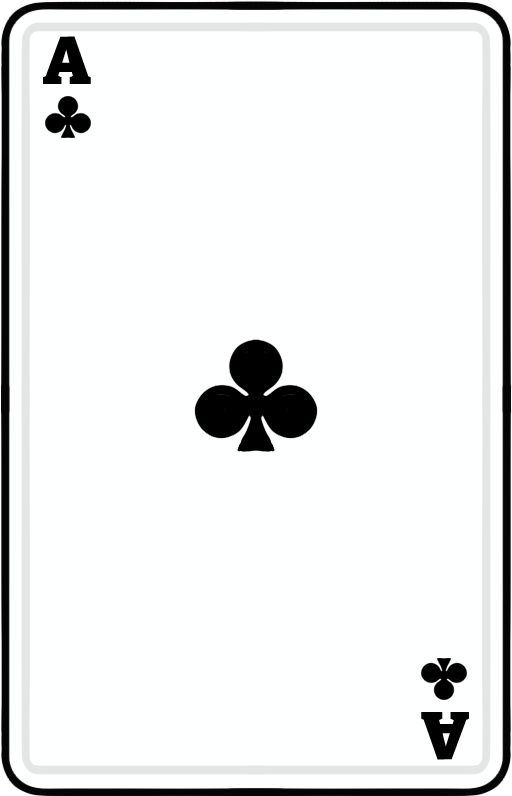
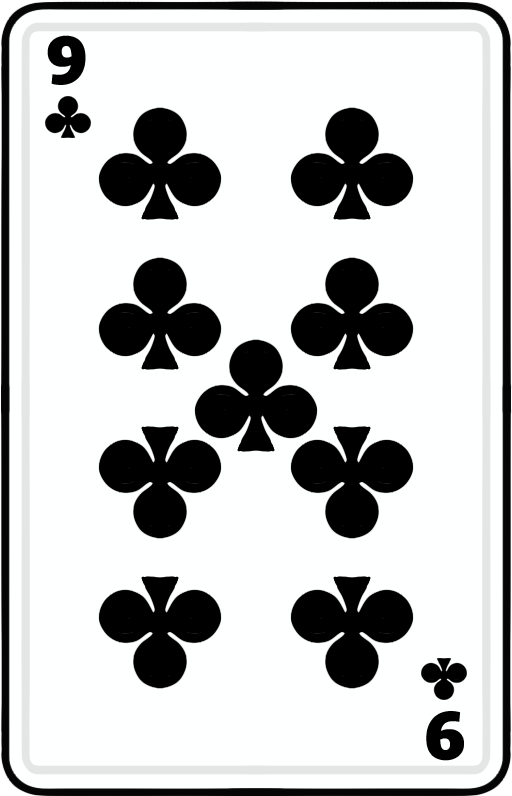
West, on the dealer's left, leads the first trick.
| Trick | Leader | Cards in order | Winner | Why |
|---|---|---|---|---|
| 1 | West | West King of spades, North Ace of spades, East Jack of spades, You 9 of clubs | North | The Ace of spades beats the King; you throw a club under your partner's winner instead of trumping |
| 2 | North | North Queen of hearts, East 10 of hearts, You Jack of diamonds, West Jack of hearts | West | North leads trump for you; your left bower loses only to West's right bower |
| 3 | West | West Queen of spades, North 10 of clubs, East King of clubs, You King of hearts | You | You are void in spades, so you trump with the King of hearts |
| 4 | You | You Ace of hearts, West 9 of hearts, North Queen of diamonds, East 10 of diamonds | You | West follows with his last trump |
| 5 | You | You Ace of clubs, West 9 of diamonds, North King of diamonds, East Ace of diamonds | You | Clubs are led, so the Ace of diamonds is off-suit and cannot win |
You and North take 4 tricks to West and East's 1, for 1 point. Four tricks score the same 1 point as three would; West's right bower was the one card that stopped a march worth 2.
Misdeals, Reneges, and Table Talk
Official euchre rules for tournaments and leagues set penalties for three kinds of mistake: a renege, a misdeal, and signaling a partner.
Renege. A euchre renege is failing to follow suit when you could have; the formal word is revoke. The usual penalty is 2 points, scored by the opponents or taken off the offending team depending on the rule sheet, and 4 against a loner. Some leagues also end the hand on the spot, and the offending team loses it. The 1888 Laws of Euchre charged 3 points for each one, or 5 in a lone hand. You cannot renege in our game: it only lets you play legal cards.
Misdeal. Under championship rules, a card exposed during the deal makes a misdeal, and some leagues take the deal away from a player who misdeals.
Table talk. Conversation is fine; signaling a partner is cheating, whether you name a card or hint at your hand with a word or gesture. Championship rules disqualify players for it, and league sheets dock points.
House Rules You Will Meet
Home tables add rules that change how a hand is dealt, made, or scored.
- Farmer's hand and going under. A farmer's hand holds only 9s and 10s. The player shows it and calls for a redeal, or goes under, swapping three cards for the three face-down kitty cards. Some leagues ban it; it is not in our game.
- Ace no face. A hand of one Ace and otherwise only 9s and 10s (some tables allow more Aces), usually answered with a redeal. Not in our game.
- Defending alone. A defender plays without a partner, often only against a loner, and scores 4 for a euchre. Not in our game.
- Canadian loner. The dealer's partner who orders up in round one must go alone, the custom in Canada, Britain, and Australia. Not in our game.
- Super-euchre. Makers who take no tricks concede 4 points instead of 2. Not in our game.
- Stealing the deal. Dealing out of turn so your side gets the up-card. One league lets it stand unless caught before the up-card is turned; others call it cheating. Not in our game.
- Holding a trump to order. Championship rules require a player who orders up to hold at least one trump, and the left bower alone counts; a dealer who picks up need not. Not in our game.
How Our Game Compares
Our game follows the standard North American rules for ranking, following suit, and scoring. Where tables split, it fixes one option in place.
| Rule | Our game | Common alternatives |
|---|---|---|
| Players | You and a computer partner against two computer opponents | 4 players in two partnerships |
| First dealer | You deal the first hand | First black Jack dealt face up, or the lowest card drawn |
| Cut | None | Offered to the dealer's right |
| Deal | One card at a time | Packets of 3 and 2 in two rounds |
| All four pass twice | Stick the dealer, always | Redeal; stick the dealer in championship and league play |
| Dealer's partner orders up | Plays with the dealer | Must go alone (Canadian loner) |
| Who may go alone | Only the maker, and the computer players never do | Some tables also allow defenders |
| Opening lead with a loner | Dealer's left; the next player if that seat is sitting out | The player on the loner's left |
| Euchred loner | 2 to the defenders | 4 at some tables |
| Makers take no tricks | 2 to the defenders | 4 (super-euchre) |
| Renege | Impossible | 2 points, 4 against a loner |
| Game | First team to 10; a hand can carry a team past it | 11 in Britain and some regions; 5, 7, 15, or 21 locally |
| Scorekeeping | On screen | Two spare low cards |
| Farmer's hand, ace no face | Not used | House rules |
Put these rules to work at euchre, where you and a computer partner take on two computer opponents in a race to 10, then visit the daily euchre challenge to see where your result ranks on that day's leaderboard. When the rules feel natural, the euchre strategy guide covers when to order up and when to go alone, and the euchre variants page covers games for two, three, and six players.
Play these rules free with a computer partner against two computer opponents, first team to 10.
Play Euchre Now